

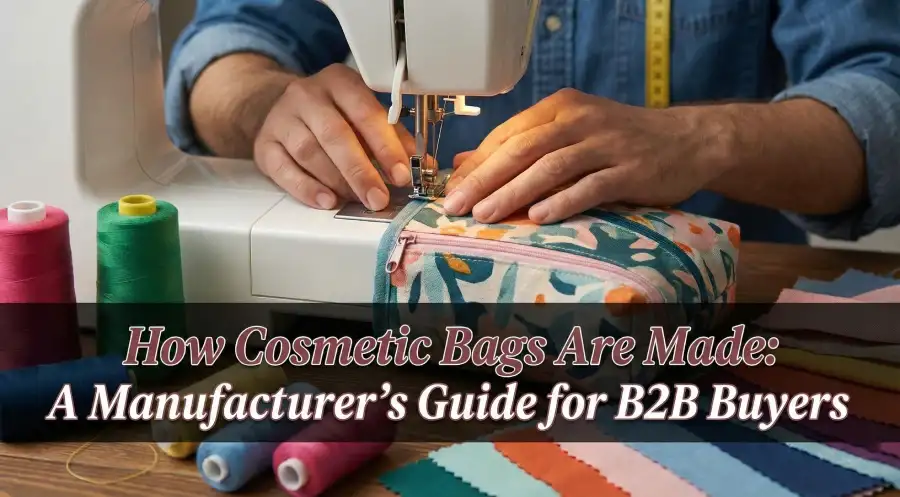
The entire purpose of cosmetic bags is to give the user a reliable and secure place to store their makeup belongings so that they have easy access to apply makeup quickly. And if that bag is flimsy and of low quality, what happens is that the user is left with a bag that does not survive daily use. A torn cosmetic bag usually becomes a hassle since many cosmetic items are delicate and can break if they drop out of the bag.
A properly manufactured cosmetic bag has a water-resistant fabric and a number of compartments to keep the cosmetics organized for easy access. In this manufacturing guide, we are going to dissect what makes a cosmetic bag user-friendly and how to select one that has mass appeal in the market and establishes you as a wholesaler that is trusted by customers.
Small-batch sewing? Flexible and great for 50–100 units. But it is not mass production.
Mass production runs depend on standardized patterns, industrial-grade cutting, synchronized assembly lines, and rigid QC frameworks. The difference is night and day. Small workshops rely on individual sewers who craft each bag independently. Factories rely on process flow: one team cuts, another stitches, another inserts zippers, another checks edges, and so on. Precision replaces intuition.
As a bulk buyer, why does this matter to you? Because when you understand factory workflows, you negotiate more effectively. You know what affects cost. You can assess production timelines without guessing. And most importantly, you ensure the quality you expect is the quality you get.
If you take only one thing from this guide, let it be this: material choice drives your final price more than anything else. You have many options to choose from: PU leather, PVC, canvas, cotton, RPET, microfiber nylon, recycled blends. But each comes with its own durability grade, finish, and long-term performance.
PU leather is the most widely used material in premium cosmetic bags. It offers a soft touch, strong structure, and excellent branding compatibility. PVC shines when you want a clear bag with waterproof appeal, usually chosen for travel or airport-friendly kits. Canvas and cotton suit earthy, textured, naturally styled brands. RPET has great appeal for environmentally conscious buyer. This is because it has the double advantage of being a recyclable material and quite durable.
Here’s the secret most manufacturers won’t always tell you: not all PU or fabrics are on the same quality level. Low-grade PU cracks after a year. High-grade PU holds shape for years and keeps its smooth surface. The density of canvas changes how it drapes or stands. The coating thickness in PVC dictates clarity and yellow-resistance. Nylon denier directly impacts tear strength.
When evaluating material samples, for a bulk order, don’t just touch and nod. Do a detailed inspection by Folding the fabric. Scratch it lightly. Stretch it to check elasticity. The quality always reveals itself under pressure. And your buyers will handle it roughly. So test it first.
Factories don’t guess their way through patterns. They engineer them. Pattern designers develop shapes that maximize fabric use while ensuring every bag from unit #1 to unit #20,000 comes out identical. CAD software helps create precise curves and seam allowances for perfect stitching. Some models require custom molds; especially for structured bags with boxed shapes.
And prototypes? Non-negotiable. This is where you confirm the size is correct, the zipper opens smoothly without wrinkling the PU, the stitching lines are clean, the inner compartments hold their shape. Buyers who skip proper prototyping often regret it. They approve a factory’s “similar sample,” trusting the final batch will match their true vision. But similar rarely equals perfect. And mistakes multiply fast in mass production.
Imagine discovering the final product’s zipper faults. Or that the lining feels cheap. Or the bag collapses when filled. Worse, imagine this after 5,000 units arrive ready for retail. A rule of thumb that works: Prototype once. Approve twice. Then move forward.
This is where manufacturing becomes very precision-oriented and surgical. Factories use die-cutting, laser cutting, or computerized machine cutting depending on order volume and bag design. Die-cutting ensures identical pieces in high-volume runs. Laser cutting offers extreme precision for complex shapes or small-batch requests. Automatic cutter machines streamline fabric usage to reduce wastage directly lowering the production cost.
But the shell fabric is only half the story. Inner linings, handles, piping strips, zipper tapes, logo patches, mesh pockets, elastic bands, pullers, and hardware components must all be cut and prepared too. A factory’s cutting precision dictates how well panels align during sewing. If cutting is sloppy, assembly becomes chaotic and inconsistent.
The main part of cosmetic bag manufacturing is done on the stitching floor.
High-volume factories use various types of machines like flatbed machines, cylinder arm machines, overlock machines, bartack machines, and binding machines to ensure every seam is uniform and reinforced. Assembly typically follows a strict order: inner pockets first, linings next, zipper attachment, body assembly, edge binding, final closing, and hardware installation.
Factories add reinforcement to stress points like corners, zipper ends, handle areas to prevent tearing during use. Edge binding prevents fraying. Structured bags sometimes require EVA or PE boards inserted during this stage to ensure the bag stands upright.
Quality control checkpoints happen in real time. Operators stop the line when they notice uneven edges, warped shapes, or misaligned prints. Why? Because fixing defects later is expensive. Maintaining consistency now saves everyone trouble later.
Branding add in the uniqueness and design complexity. Your options for branding are plenty. Common branding techniques include heat transfer prints, silk screen prints, digital prints, debossing on PU leather, embroidery on fabric, metal logo plates, woven labels, rubber patches, and foil stamping. Each option affects MOQ, lead time, and pricing.
Heat transfer prints offer quick turnaround but fade faster than screen prints. Embroidery looks premium but costs more and demands thicker fabrics. Metal logos elevate luxury bags but require mold fees. Debossing on PU adds a sophisticated finish but needs precise temperature and pressure calibration.
Private-label buyers should always clarify the specifics of branding to the manufacturer. This includes all kids of aspects like logo placement, size, colors, material compatibility, and finishing texture. No assumptions. Factories interpret instructions literally. And ambiguities turn into real-world defects fast.
Quality control is not a single step it encompasses every stage of manufacturing. Factories run multiple stress tests: seam pull tests, zipper strength tests, load-bearing tests, waterproofing assessments, and lining adhesion checks. Colorfastness testing ensures dyes don’t bleed onto cosmetics inside the bag. Structural checks confirm the bag stands straight and doesn't warp.
For large orders, third-party inspection is worth every dollar. It reduces disputes. It protects your shipment. It ensures objectivity. Factories respect brands that take QC seriously.
Packaging decides how your product survives the journey. Most cosmetic bags use simple OPP polybags for unit packaging. Higher-end models go inside dust bags or rigid gift boxes. For bulk packaging, factories use export-ready cartons lined with protective layers to prevent crushing. Palletizing helps stabilize large shipments, and well-planned container loading reduces freight damage. Packaging also affects cost. Gift boxes increase size and weight. Thicker cartons raise shipping fees. Better packaging equals better product protection but balance is everything.
Every cosmetic bag price is a formula. Material type and thickness set the base cost. A thicker PU, a heavy-denier nylon, or eco-certified RPET will push costs higher. Customization complexity from multicolor prints to metal logos, increases labor and mold fees. Volume and MOQ dramatically shift pricing because factories prefer stable, high-volume production.
Labor intensity matters too. Bags with multiple compartments, reinforced stitching, elaborate shapes, or lining structures require more hands-on work. And if you place an order during peak season or request faster production, prepare for added charges.
Understanding these factors arms you with negotiating power.
Factories can produce nearly every style you see in retail, including structured PU cosmetic pouches, transparent PVC makeup bags, multi-layer travel organizer sets, foldable or hanging toiletry bags with hooks, high-end luxury bags with metal hardware, and sustainable RPET bags aimed at eco-conscious markets.
The beauty of mass production is consistency. Once your patterns, materials, and branding details are fixed and communicated to the manufacturer, the factory can reproduce thousands with flawless efficiency
Not all factories are equal. Search out manufacturers that follow quality certification in their manufacturing process. Some industry specific quality standards include ISO or BSCI certifications. Another aspect to keep in mind during manufacturer selection is to inquire what sort of equipment they use for manufacturing. State-of-the-art factories use automatic cutters, digital printers, PU molding machines, and embroidery machines because capability defines quality.
Sample policy matters. Fast sample turnaround indicates operational maturity. Slow sampling often predicts slower mass production.
Communication is everything. A good manufacturer responds clearly, and asks relevant questions, and provides solutions before problems even arise. After-order support, handling replacements, documenting production, and providing shipment photos all reflects professionalism. The manufacturer you choose becomes part of your brand. Choose wisely.
Understanding the cosmetic bag manufacturing process is not just technical knowledge it also helps in negotiation and sharpens your sourcing decisions. It helps you evaluate quality before production, not after.
When you know how bags are made, you buy smarter. You build better products. You scale with confidence.
If you’re ready to take your next step, request custom quotes, sample packs, or full product catalogs. Your next best-selling cosmetic bag starts with the right manufacturing partnership.
Choosing between shopping bags and tote bags is not a design preference. For businesses, it is a decision that affects cost, customer experience, brand visibility, and long-term value. Wh...
READ FULLFor school bag importers, market insights aren’t a “nice-to-have.” They quietly shape the expectations buyers carry into every negotiation, every sample request, every compliance ...
READ FULLThe entire purpose of cosmetic bags is to give the user a reliable and secure place to store their makeup belongings so tha...
READ FULL