

Analysis of school bag procurement contracts from 47 different importers over three years reveals a clear pattern: the best suppliers don't just happen to meet standards. They were shaped by the markets they serve.
When a Turkish exporter supplies German school districts, their chemical testing documentation tends to be comprehensive. When a Vietnamese manufacturer maintains long-term contracts with US retailers, reinforced stitching specs and CPSIA compliance folders come standard. This isn't coincidence. Markets with higher expectations create exporters with better systems.
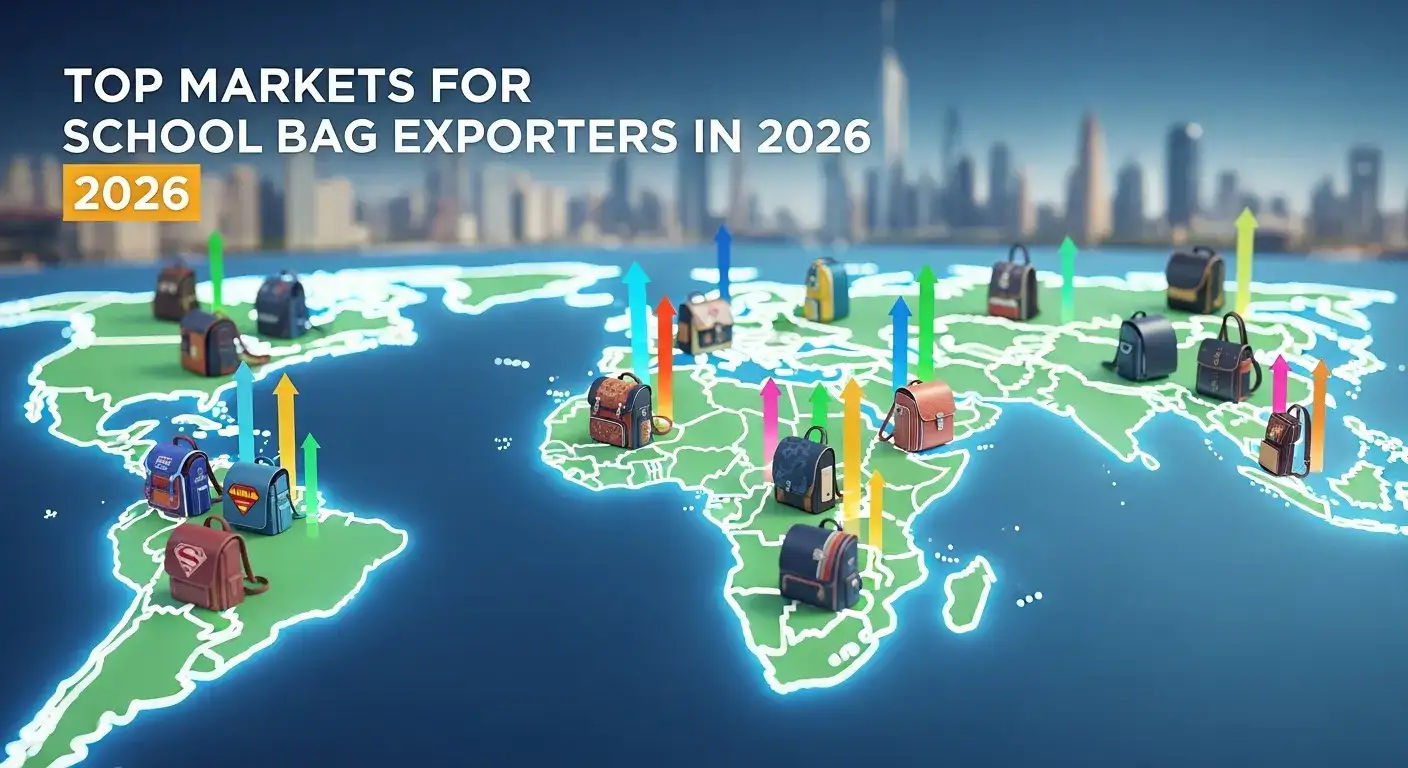
This guide breaks down five major school bag import markets and shows exactly what to look for when an exporter claims experience in each region. Importers can reverse-engineer an exporter's quality level by asking which markets they serve.
Volume alone doesn't create quality pressure. India imports millions of school bags annually, but much of that demand flows through price-sensitive distributors with minimal compliance requirements. Compare that to Denmark, which imports far fewer units but requires REACH compliance documentation, recycled material certifications, and ergonomic testing reports.
The difference? Regulatory enforcement and buyer sophistication.
High-demand markets share four characteristics:
Strict safety and chemical compliance with actual border enforcement (not just laws on paper)
Organized retail channels that audit suppliers and reject non-conforming batches
Concentrated buying power (large school districts, chain retailers, ministry tenders) that can afford to be selective
Transparent complaint mechanisms that create reputational risk for exporters who ship defective products
When these four factors align, exporters either upgrade their processes or lose access to the market. That upgrading is what you're buying when you source from an exporter with proven experience in demanding regions.
US and Canadian school bag imports hit $847 million in 2024 (US Census Bureau trade data). The majority flows through three channels: big-box retailers (Walmart, Target), specialty chains (Staples, Office Depot), and direct-to-school district contracts.
Every single one of these channels requires CPSIA compliance. This isn't optional documentation that can be negotiated around. US Customs and Border Protection randomly tests shipments. If a batch fails lead or phthalate limits, the entire container gets held at port. Importers have lost $180,000 on single rejected shipments because their exporter's test reports were three years old and used an uncertified lab.
Ask for client references you can verify. Don't accept vague claims like "we export to America." Get specific: Which retailer? Which school district? What volume per order? A real exporter serving Walmart will have documentation showing 15,000+ unit shipments with predictable reorder cycles.
Request copies of their most recent third-party lab reports. Look for testing done by US-recognized labs (SGS, Bureau Veritas, Intertek) within the last 12 months. The report should cover lead content, phthalate levels in PVC components, and sharp edge testing for zipper pulls.
Examine their material sourcing. North American buyers expect 600D polyester minimum for daily-use backpacks. Check if the exporter can provide mill certifications for their fabrics. Ask about their zipper supplier—YKK or SBS zippers are standard. Generic Chinese-made zippers break after 2-3 months of use.
Durability matters because American consumers keep school bags for 2-3 years and expect them to survive heavy textbooks, laptop compartments loaded with 3-4 pounds, and frequent washing. An exporter serving this market will have load-testing data showing strap strength of at least 50 pounds.
European school bag imports were valued at €612 million in 2024 (Eurostat). Germany, France, UK, and the Netherlands account for 68% of that volume. Unlike North America's focus on physical durability, Europe prioritizes chemical safety and environmental impact.
REACH (Registration, Evaluation, Authorization of Chemicals) is the law that matters. It restricts thousands of chemicals in consumer products. An exporter claiming European experience should be able to produce a REACH compliance declaration without hesitation. This document lists every chemical used in dyes, coatings, and plastic components, along with their CAS numbers and concentrations.
Review of 30+ compliance declarations shows a clear quality divide. Comprehensive declarations run 8-12 pages and include third-party test reports for each restricted substance category (phthalates, azo dyes, heavy metals, flame retardants). Inadequate declarations are two-page templates with blank fields for test data.
Recycled polyester (rPET) isn't a premium feature anymore. It's becoming baseline. A procurement manager at a German school supplier network recently reported that their 2026 contracts require at least 30% recycled content in all polyester fabrics. Exporters without rPET sourcing relationships are getting dropped from bid lists.
Ask potential exporters: Where do you source your rPET fabric? Can you provide GRS (Global Recycled Standard) certification? How much does it increase unit cost compared to virgin polyester?
A good answer includes specific mill names (Far Eastern New Century, Repreve, Unifi), percentage cost increases (typically 8-15% premium), and current lead times (rPET fabrics often require 2-3 weeks longer than virgin polyester because fewer mills produce them).
Middle East school bag markets operate differently than Western retail. The UAE, Saudi Arabia, Qatar, and Kuwait purchase primarily through three channels: ministry of education tenders, private school network contracts, and large retail chains (Carrefour, Lulu, Spinneys).
Tender-based procurement means huge volumes with strict delivery windows. A typical Saudi ministry tender covers 200,000-500,000 bags delivered in 8-10 weeks before the school year starts. Exporters serving this market have experience with compressed timelines, penalty clauses for late delivery, and quality inspections conducted by third-party agencies hired by the buyer.
Heat resistance matters because bags sit in 45-50°C temperatures for months. Cheap PU leather handles can crack and peel after one summer in a Riyadh storage facility. Zippers seize up when low-grade lubricants evaporate in extreme heat. Fabrics fade unevenly if dyes aren't heat-stable.
Ask about their largest single order. If the exporter claims Middle East experience but their biggest order was 5,000 units, they're not serving the regional tender market. Real players in this space handle 50,000+ unit orders multiple times per year.
Request documentation on their heat testing procedures. Do they expose samples to 50°C for 72 hours and check for delamination, color shift, or zipper function degradation? Can they show you before/after photos?
Verify their understanding of halal certification requirements. While not universal, some Gulf market buyers require certification that no pig-derived components (certain gelatin-based adhesives, leather trims) are used in production. An exporter familiar with the region will know when this requirement applies.
These markets get lumped together in industry reports, but they're evolving fast. Indonesia, Philippines, Vietnam, Nigeria, Kenya, and South Africa have rapidly growing middle-class populations sending kids to private schools. Those parents want branded bags with good-looking designs, not just functional cheapest-available options.
The split is happening inside these markets. Budget-tier bags still dominate volume (400-700 rupiah in Indonesia, 1,500-2,500 Kenyan shillings). But the premium segment (2,000+ rupiah, 5,000+ KES) is growing 15-20% annually according to local distributor data.
Cost-efficient production requires different skills than premium production. An exporter serving Southeast Asian distributors should demonstrate expertise in material optimization (using 420D polyester instead of 600D while maintaining adequate strength), simplified construction (fewer compartments, no internal organization panels), and supply chain efficiency (shorter fabric-to-finished-goods cycles).
The mistake importers make is assuming 'low-price market' means 'accepts defects.' It doesn't. A bag sold for $3 wholesale still needs zippers that work and stitching that holds. The difference is in material grade and feature count, not in basic construction competence.
Ask exporters: What's your lowest-tier bag specification? At what price point can you deliver 10,000 units with 30-day payment terms? Can you show me samples from your budget line and explain exactly where you reduced cost compared to your mid-tier products?
Here's an effective sourcing framework for importers:
Step 1: Define your quality tier. Are you targeting Walmart-level durability, Aldi-level budget efficiency, or boutique retail?
Step 2: Identify which major market matches that tier. Premium durability = North America. Sustainability focus = Europe. Bulk institutional = Middle East. Cost optimization = Southeast Asia/Africa.
Step 3: Filter exporters by proven experience in that matching market. Don't accept vague claims. Ask for verifiable client names, shipment documentation, and region-specific compliance certificates.
Step 4: Cross-check their material sourcing against market standards. European exporters should have rPET supply chains. North American exporters should use certified labs. Middle East exporters should show heat-testing protocols.
This approach eliminates 60-70% of unsuitable suppliers in the first conversation. You're not screening on price or factory size. You're screening on whether the exporter's existing systems match your requirements. That's faster and more reliable than trying to train a cheap factory to meet standards they've never had to meet before.
When an exporter claims North American experience:
Request client names and verification contact information (buyer email or phone)
Ask for CPSIA test reports less than 12 months old from SGS, Intertek, or Bureau Veritas
Verify zipper supplier (YKK or SBS should be standard)
Review fabric specifications (600D minimum for daily-use bags)
Check for strap load testing documentation (50+ pound capacity)
When an exporter claims European experience:
Request full REACH compliance declaration with CAS numbers
Ask about rPET sourcing capabilities and GRS certification
Verify mill names for recycled polyester fabrics
Check third-party test reports for restricted substances
Confirm understanding of EU low-impact dye requirements
When an exporter claims Middle East experience:
Ask about largest single order volume (should be 50,000+ for tender experience)
Request heat resistance testing protocols (50°C for 72 hours)
Verify experience with penalty clauses and compressed delivery timelines
Check knowledge of halal certification requirements
Confirm third-party inspection acceptance (SGS, TUV, etc.)
Every importer wants the same thing: predictable quality at a competitive price with minimal surprises. The fastest way to get there is choosing exporters whose existing systems already match requirements.
Market experience provides that match. An exporter serving European buyers for three years has already solved the REACH compliance documentation problem. An exporter with active North American contracts has already built relationships with certified testing labs. An exporter handling Middle East tenders has already figured out heat-resistant material sourcing.
This experience doesn't cost extra. It avoids the cost of being the guinea pig client who discovers all weak points through rejected shipments and compliance failures.
Market analysis works as a primary sourcing filter. It's more predictive than factory tours, cheaper than trial orders, and faster than auditing internal processes. Understanding which markets demand what, verifying exporter claims against those benchmarks, can cut bad-supplier rates by more than half.
Material is the first decision in a cosmetic bag order, and it affects almost everything after it: how the bag looks on a shelf, how it handles spills, how it ages in a humid bathroom, and what pap...
READ FULLIf you are adding private label cosmetic bags to your beauty product line, the biggest sourcing mistake is treating them like a standard stock purchase....
READ FULLNothing makes a retail season fail faster than a shipment of subpar tote bags. You've been there, or at least you've heard the horror stories from fellow distributors: ...
READ FULL