

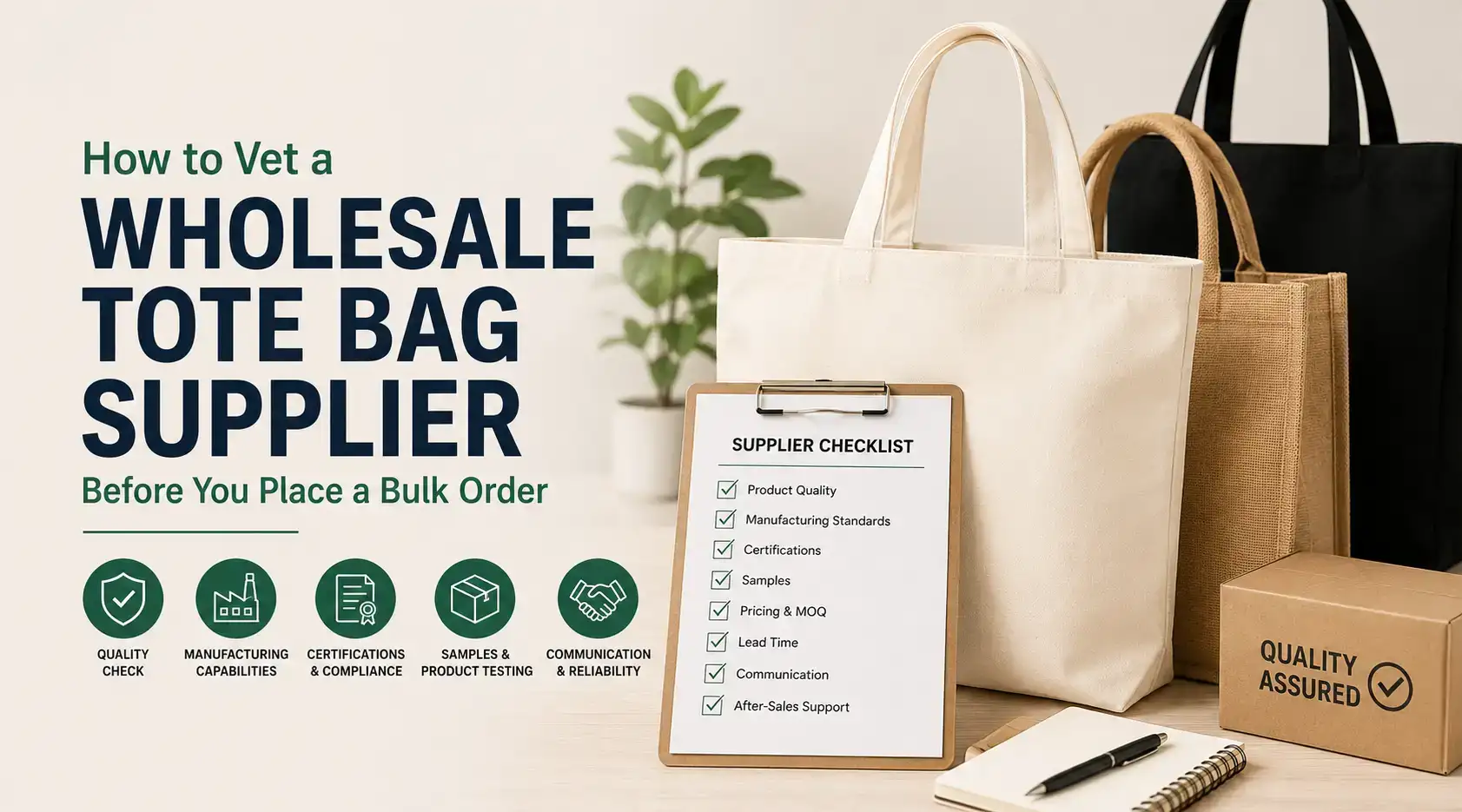
Nothing makes a retail season fail faster than a shipment of subpar tote bags. You've been there, or at least you've heard the horror stories from fellow distributors: handles that snap on the first use, colors that faded before the customer even left the store, or the absolute nightmare of a container arriving two weeks past your launch date.
The relationship you build with your wholesale tote bags supplier isn't just transactional. It forms the foundation of your product quality and, ultimately, your bottom line. Whether you're a retailer stocking shelves, a promotional product company fulfilling a major corporate order, or an importer navigating the complexities of global sourcing, this choice determines your profitability as much as it determines customer satisfaction.
But the reality is that not all suppliers are created equal, and the price-per-unit differential you see on an Alibaba listing never tells the full story. Far too many businesses make costly decisions based on surface-level research, only to pay for it tenfold in returns and rush shipping fees.
The good news? A thorough vetting process doesn't require weeks of detective work. It requires knowing exactly what to look for and having the discipline to check every box before you commit. Let's walk through exactly how to do that.
Before we dive into the specifics, let's establish one thing: this vetting process isn't optional. This is the most important investment of time you'll make in your product development cycle. Think of it as your insurance policy against operational disaster.
Every supplier will tell you they're the best, the fastest, the most reliable. Your job isn't to take their word for it but to verify what they're promising. This framework covers five pillars of supplier evaluation. Implement it seriously, and you'll not only find a capable partner but also avoid the regret of chasing down a supplier who overpromises and underdelivers.
This is where most buyers start, and for good reason. The materials in your tote bag are the first thing your customers will touch, and that first touch forms an immediate impression about value and durability. Here's what you need to dig into.
Each material serves a different purpose and has distinct quality characteristics. Canvas offers structure and durability, making it ideal for everyday totes. If you're sourcing canvas styles, our wholesale canvas tote bags are a good reference point for construction standards to benchmark against. Cotton, often unbleached or organic, delivers a soft, natural feel, but its lack of rigidity limits it to selective designs. Oxford is a synthetic weave known for water resistance and affordability. rPET (recycled polyester) is increasingly popular for eco-conscious brands, but quality varies dramatically between suppliers.
Don't just ask "what's your material?" Ask for the specific weight in GSM and full construction details. A 600D Oxford is not the same as a 900D Oxford, and that difference shows up in your customers' hands.
GSM tells you the fabric's density. Higher GSM generally means thicker, more durable fabric, though it also increases shipping costs. For standard canvas totes, 200 to 300 GSM is common for lightweight promotional bags. Anything 400 GSM and above signals premium durability. Your supplier should provide GSM data without hesitation.
The failure points in any tote bag are the seams. Inspect sample bags closely. Are the stitches even and tight? How many stitches per inch? Are there reinforcing stitches at high-stress points?
Handle attachment is where many suppliers quietly cut costs. Check how handles are attached at the base of the bag. Riveted reinforcement or bar-tack stitching at the connection point is the mark of a supplier who isn't cutting corners.
If you're ordering 10,000 pieces, every single bag should match your approved sample. Ask about dye quality, lot consistency, and whether the supplier batches materials from the same production run. Color variations that look minor on a swatch become obvious when bags sit side by side on store shelves.
Never skip this step. Order a physical sample before any bulk production. Examine it in natural lighting and test its load-bearing capacity against your specifications. A sample that's "almost right" is a predictor of bigger problems at scale. Browse our wholesale tote bags collection to identify styles worth requesting samples for.
Your 10,000-piece order isn't going to make itself, and a supplier's ability to deliver on time is every bit as important as product quality.
Ask directly: "What's your monthly production capacity in units?" Follow up with: "Is that capacity available for new orders, or is your factory already at capacity?" That answer tells you whether they can process your order without disrupting their existing client base.
Can the supplier customize designs from your specifications (OEM), or can they offer design and development services (ODM)? This matters when your tote needs specific dimensions, branding placement, or unique features. Many suppliers claim OEM capabilities, but the level of expertise varies widely.
A supplier with a solid factory will be proud to show it. Ask for a virtual tour, video calls showing production lines, or recent factory audit certificates. Hesitation here is a signal worth paying attention to.
Who is checking the products before they ship? A defined QC process covering pre-production inspections, in-line checks, and final pre-shipment inspections is non-negotiable. Ask for their quality control protocol in writing.
Realistic lead times are the difference between meeting your launch date and missing it. Factor in production time, sample approval, and shipping. Any supplier who promises delivery that sounds too fast is probably compromising something. Ask for a timeline that includes buffer for unexpected delays.
This is the part of vetting that many buyers rush past, and it's where the biggest legal and financial liabilities hide. We've covered compliance verification in depth for school bag exporters, and the same verification principles apply here.
If you're selling into the European market, REACH compliance is mandatory. This regulation restricts hazardous substances in consumer goods. Your supplier should provide REACH documentation with test results. Verbal assurances are not enough.
For the US market, the Consumer Product Safety Improvement Act imposes strict standards, particularly around lead content and phthalate limits. Even if your totes aren't for children, CPSIA requirements may still apply to your materials.
Ask for third-party lab test reports covering the specific materials in your bag. Suppliers who test regularly will have these ready. If they send you generic or outdated reports, request current, product-specific testing.
Detailed breakdowns of all materials, including coatings, dyes, and finishes, let you control your product's composition and substantiate any marketing claims.
If you're marketing recycled content, GRS certification matters. It verifies that the recycled material is genuinely traceable throughout the supply chain. Without it, a "recycled" claim is greenwashing.
What is the smallest order they will accept? Many suppliers have flexible MOQs for sample runs but higher minimums for production. If your volume falls below their threshold, they may not be the right fit.
Beyond your initial order, how does pricing scale with volume? Ask for tiered pricing at intervals that reflect your potential growth. This tells you whether a long-term partnership is financially viable.
Most suppliers charge for samples, and that's normal. What matters is whether they're upfront about it, whether sample fees are refundable against bulk orders, and whether shipping costs are clearly communicated.
Standard terms commonly include a 30% deposit with 70% balance before shipping. Some suppliers offer Net 30 to established relationships. More favorable terms can sometimes come at a higher per-unit cost, so weigh the trade-off.
Who is responsible for logistics, insurance, and customs clearance? Terms like FOB (Free on Board), CIF (Cost, Insurance, Freight), and EXW (Ex Works) assign different responsibilities to the buyer and seller. Clarify this before you commit.
Get quotes for both air and sea freight. Transit time versus cost is a strategic decision based on your timeline and margins. A good supplier will help you understand the options rather than push you toward one.
This is the softer side of vetting, but in practice, it's where deals succeed or fail.
How quickly do they reply to emails or messages? A supplier who takes days to respond to a sales inquiry will take even longer when your order is in production and something goes wrong.
Ordering a sample tells you three things: the quality of the product, the care the supplier puts into their work, and how seriously they take you as a potential client. The sample process from order to delivery reveals a great deal about what bulk production will look like.
If the sample isn't right, can they make revisions promptly and accurately? Their ability to correct mistakes during sampling is a reliable sign of how responsive they'll be during production.
Once your order is in production, how do they keep you updated? Ask specifically: Will you receive milestone updates? Who is your point of contact? What's the escalation path if something goes wrong? Suppliers who can answer this clearly have done it before.
Before the goods leave the factory, will you receive photos or be able to arrange an independent inspection? This is your last opportunity to catch defects before they hit the shipping container.
Keep this checklist handy for every supplier conversation.
| Check | Questions to Ask |
|---|---|
| Materials | What materials and GSM options are available? |
| Quality | Can I inspect a sample before ordering? |
| Capacity | Can you handle my required volume? |
| MOQ | What is your minimum order quantity? |
| Compliance | Can you provide relevant documentation? |
| Customization | Can you support OEM/ODM requirements? |
| Lead Time | What is the realistic production timeline? |
| Pricing | Are volume discounts available? |
| Communication | Who will manage my order? |
| Shipping | What Incoterms and shipping options are available? |
If you're weighing your options, Vaelobag Global is worth a close look, not because we say so, but because our approach aligns with every standard in this guide.
We offer canvas, cotton, Oxford, and certified rPET across our wholesale tote bags range, with transparent GSM specifications and full material declarations available on request.
Our factories maintain consistent monthly production capacity with documented quality control procedures we share openly with prospective clients. You can read more about our history and production capabilities on our About Us page.
OEM and ODM are core capabilities. We've developed over 200 unique tote designs for clients across the US, Europe, and Asia. See an example of our custom work in the Women's Splicing Canvas Tote Bags, with dual handle construction and zipper closure, available for private label.
We structure MOQs flexibly to accommodate both small-batch and large-scale orders, with clear pricing breaks at every tier.
Pre-production, in-line, and pre-shipment inspections are standard protocol across every order.
We maintain REACH, CPSIA, and GRS documentation ready for client review, with third-party lab testing available on request.
We work with buyers on FOB, CIF, and EXW terms depending on what suits your supply chain and logistics setup.
The supplier you choose today has a ripple effect on your business for months. Rushing the vetting process to save a week or two can create problems that take much longer to resolve. Doing this work thoroughly positions you to build a partnership that actually grows with your business.
Skipping steps to save a few days of vetting rarely pays off. It just moves the cost downstream, to returns, rush freight, and disappointed customers. If you're comparing bag formats before you get to the supplier stage, our Shopping Bags vs. Tote Bags guide breaks down which format actually fits your use case.
Take this framework, apply it to every supplier conversation, and pay attention when the answers don't add up.
Ready to get started? Request a quote or discuss your bulk tote bag requirements with Vaelobag Global.
Material is the first decision in a cosmetic bag order, and it affects almost everything after it: how the bag looks on a shelf, how it handles spills, how it ages in a humid bathroom, and what pap...
READ FULLIf you are adding private label cosmetic bags to your beauty product line, the biggest sourcing mistake is treating them like a standard stock purchase....
READ FULLNothing makes a retail season fail faster than a shipment of subpar tote bags. You've been there, or at least you've heard the horror stories from fellow distributors: ...
READ FULL