

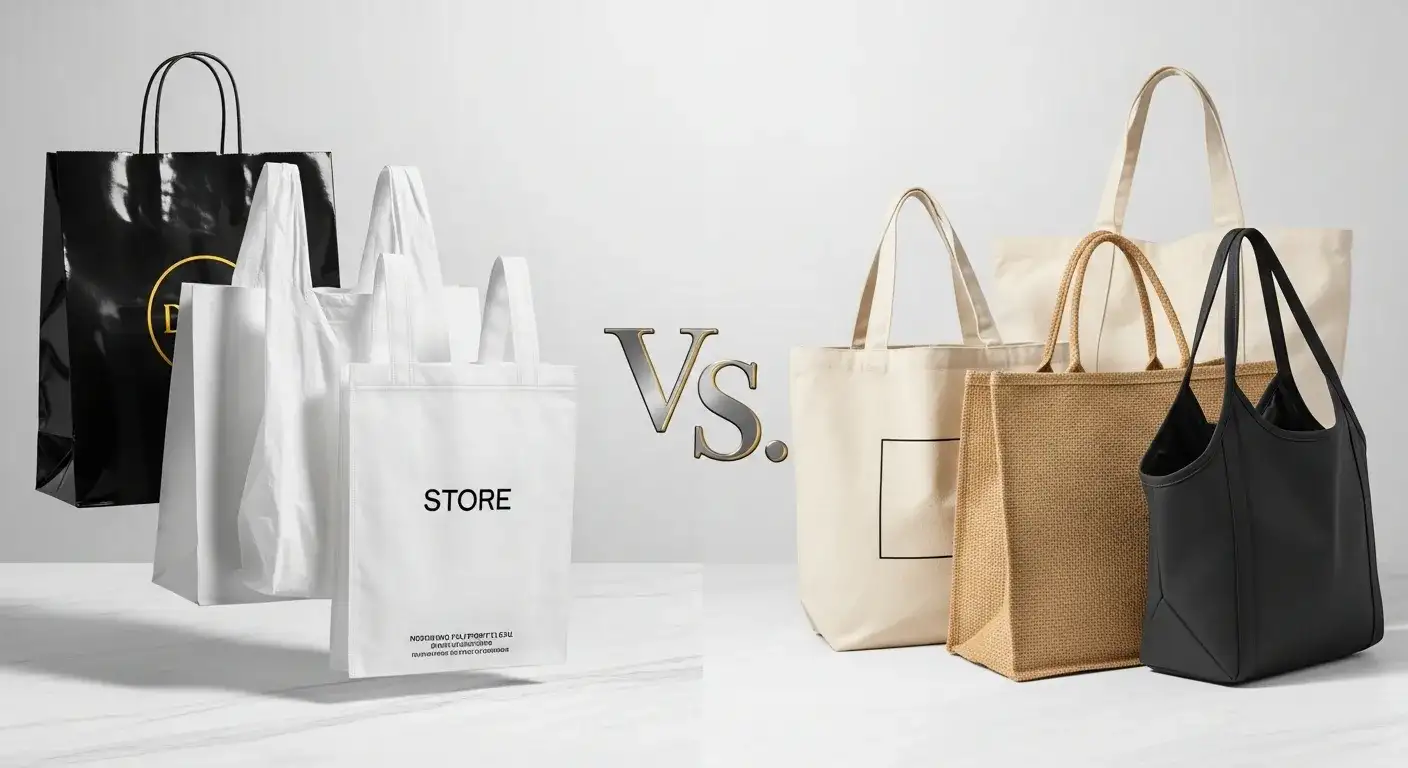
Choosing between shopping bags and tote bags is not a design preference. For businesses, it is a decision that affects cost, customer experience, brand visibility, and long-term value. While shopping bags and tote bags may appear similar at first glance, they serve very different roles in retail, promotions, and brand strategy.
This guide compares shopping bags vs. tote bags from a B2B perspective, covering materials, durability, branding lifespan, sustainability, and ideal use cases. The goal is simple: help retailers, wholesalers, and brand owners choose the bag that actually fits how their customers behave.
|
Feature |
Shopping Bags |
Tote Bags |
|
Primary Purpose |
Carry purchases from store to home |
Long-term reuse and branding |
|
Typical Lifespan |
1–3 uses |
Months or years |
|
Common Materials |
Kraft paper, laminated paper, non-woven PP |
Canvas, jute, rPET, denim |
|
Branding Exposure |
Short-term |
Long-term |
|
Per-Unit Cost |
Low |
Medium to high |
|
Best Use Cases |
Retail checkout, food delivery |
Promotions, events, merchandise |
Plastic bans and sustainability regulations did more than change materials — they changed expectations. Customers now carry bags farther, reuse them more often, and notice failures such as weak handles or torn seams. As a result, bags have shifted from being disposable packaging to visible brand touchpoints.
This shift blurred the line between packaging and product. A bag is no longer just a way to transport items; it is something customers interact with repeatedly. That repeated exposure magnifies both quality and flaws, making the right bag choice more important than ever for businesses.
Shopping bags are designed for short-term utility. Their primary role is to efficiently and affordably move purchased items from the store to the customer’s home.
Modern shopping bags are typically made from:
Kraft paper, often reinforced with twisted paper handles.
Laminated paper, offering better moisture resistance and surface durability
Non-woven polypropylene (PP), which mimics fabric but behaves like plastic
Biodegradable plastic alternatives, such as starch-based films, are also used to meet regulations, though they generally sacrifice strength. Shopping bags prioritize low cost, easy storage, and fast production, not longevity or style.
Tote bags are built for repeat use. Unlike shopping bags, they are meant to be kept, carried, and reused across different settings.
Common tote bag materials include:
Cotton canvas
Jute
Recycled PET (rPET) fabrics
Heavy twill or denim
Their construction emphasizes stitched seams, reinforced handles, and higher load capacity. Tote bags are often treated as branded merchandise rather than packaging. Many brands sell or distribute them as promotional items, knowing they will remain in public circulation long after the initial transaction.
Shopping bags are optimized for speed and efficiency. Their boxy shapes accommodate retail products, and their smooth surfaces simplify bulk logo printing. Design choices focus on ease of use and cost control.
Tote bags follow a different philosophy. Elements like gussets, pockets, strap length, and fabric texture are chosen to balance function with appearance. A tote bag becomes part of how a customer presents themselves, turning the bag into a wearable brand asset rather than disposable packaging.
Paper shopping bags are constantly stressed at the handle anchor points. To improve performance, higher-quality bags are used:
Paper grades above 180 GSM
Reinforced handle areas
BOPP lamination to resist humidity and tearing
Even with these improvements, shopping bags are designed for limited use, not extended lifespans.
Tote bags rely on textiles for strength. Cotton canvas and rPET fabrics offer high tensile resistance, while stitch density plays a critical role in load-bearing capacity. Reinforcement patches beneath strap anchors are essential to prevent tear-out under load. These construction details determine whether a tote bag lasts weeks or years.
Shopping bags often become uncomfortable when overloaded. Paper handles can cut into the hand, and die-cut handles collapse under strain. This is generally accepted because carry distances are short and usage is temporary.
Tote bags are designed for longer carry times. Strap width affects comfort, while handle drop length determines whether the bag sits comfortably at the hip or swings awkwardly. Poor internal structure leads to clutter, while excessive stiffness reduces usability. Comfort directly influences how often a tote is reused — and how often a brand is seen.
Shopping bags are optimized for fast logo printing. Flexographic printing enables high-volume production, while screen printing adds opacity for simple designs. Branding exposure, however, ends quickly once the bag is discarded.
Tote bags offer far greater branding longevity. Options include:
Heat transfer prints
Water-based inks that age naturally with fabric
Embroidery for permanence
Customization on tote bags is less about decoration and more about a lasting impression. A tote that remains in circulation for months delivers ongoing brand visibility at no additional cost.
Paper shopping bags are recyclable, but still contribute to deforestation and energy consumption. Non-woven polypropylene is often marketed as reusable, yet it can persist in landfills if not recycled properly.
Tote bags promise sustainability only when reused frequently. Cotton totes require significant water resources to produce, meaning they must replace hundreds of single-use bags to offset their footprint. Recycled PET totes improve circularity but depend on effective recycling infrastructure. Sustainability is not just about material — it is about actual usage behavior.
Shopping bags have a low per-unit cost, compact storage requirements, and predictable logistics. However, they are consumed quickly and offer limited long-term brand value.
Tote bags require higher upfront investment, more storage space, and additional production labor. Their value emerges over time through repeated use and extended brand exposure. The real cost is not what is paid upfront, but what the bag delivers over its lifespan.
Shopping bags are ideal when:
Carry distances are short.
Cost efficiency is critical.
Items are lightweight or pre-packaged.
Common B2B use cases include:
Retail checkout counters
Fashion boutiques
Gift shops
Food delivery services
Exhibition booths distributing catalogs
In these scenarios, the bag’s role is functional and temporary.
Tote bags perform best when:
Brand visibility beyond the point of sale matters
Products or materials are heavy.
The bag itself is part of the customer experience.
Typical use cases include:
Trade shows and corporate events
University campuses
Promotional giveaways
Lifestyle and premium retail brands
Here, the bag becomes a long-term brand carrier, not just packaging.
The right choice depends on customer behavior after purchase. Businesses should consider:
Do customers walk, commute, or drive?
How far will the bag be carried?
Is branding exposure a priority beyond checkout?
What load will the bag carry?
Lightweight cosmetics may work perfectly in paper shopping bags. Heavy catalogs or promotional materials require strong fabric. Choosing the wrong bag does more than inconvenience customers — it undermines trust and brand perception.
Shopping bags and tote bags are not competitors; they are tools designed for different outcomes. Shopping bags support fast-moving retail and cost efficiency. Tote bags extend brand presence and reinforce identity through repeated use.
The correct decision is not based on trends or aesthetics, but on how customers actually live, move, and reuse. When the function aligns with customer behavior and branding goals, the bag fades into the background — and that is when it delivers its greatest value.
Material is the first decision in a cosmetic bag order, and it affects almost everything after it: how the bag looks on a shelf, how it handles spills, how it ages in a humid bathroom, and what pap...
READ FULLIf you are adding private label cosmetic bags to your beauty product line, the biggest sourcing mistake is treating them like a standard stock purchase....
READ FULLNothing makes a retail season fail faster than a shipment of subpar tote bags. You've been there, or at least you've heard the horror stories from fellow distributors: ...
READ FULL