

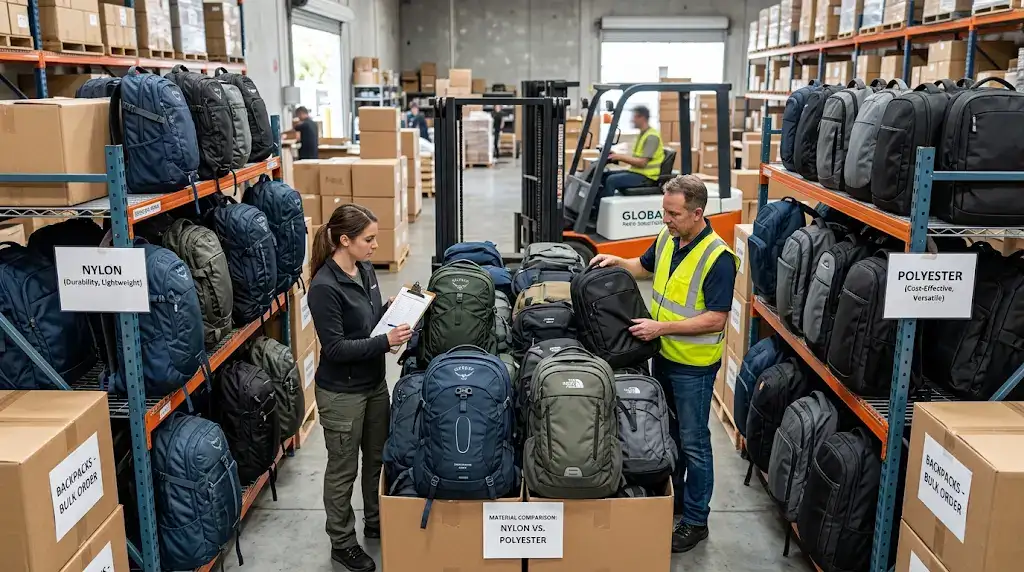
Most bulk backpack problems start at the spec sheet. A buyer approves “600D polyester” or “nylon, water resistant,” the container ships, and months later the complaints arrive: coating that peels, colors that fade in a shop window, straps that fray at the anchor point. Fabric choice sets the unit cost, weight, printing options, and how a bag tends to fail. This guide covers how nylon and polyester differ in ways that show up in real orders, and what to write into your purchase spec so those differences are settled before production starts.
Polyester is usually cheaper, holds color and strength better in sunlight, and takes full-surface printing. Nylon is lighter for the same strength, resists abrasion better, and usually costs more. Neither is better in general. The right choice depends on where you'll carry the bag and how you plan to sell it.
Nylon 6,6 has a density of about 1.14 g/cm³. Polyester (PET) has a density of about 1.38 g/cm³. With similar fabric construction, nylon comes out lighter, which is one reason travel and hiking packs lean toward it.
Nylon generally outlasts polyester in abrasion testing. That matters most on the base panel, which gets dragged across floors, car trunks, and bus aisles. Polyester is not weak, but if the bag will be dropped and scraped daily (couriers, field staff, students on gravel), the extra cost of nylon usually pays for itself.
Nylon absorbs roughly 4 percent of its weight in moisture at standard conditions. Polyester absorbs under 1 percent. Wet nylon stretches, loses some strength, and dries slowly. Polyester behaves almost the same wet or dry. Neither fiber is waterproof on its own, so rain performance depends on the coating, covered below.
Polyester has better UV resistance. Nylon fades and weakens faster under long exposure. If your bags will sit in store windows, be carried outdoors in a sunny climate, or be handed out at open-air events, this counts for more than most buyers expect.
Denier is the weight in grams of 9,000 meters of yarn. A 600D yarn is thicker than a 210D yarn. It says nothing about weave tightness or how the fabric will wear.
Buyers get misled when they compare across fibers. Because polyester is denser, a 600D polyester filament is thinner than a 600D nylon filament. Two fabrics with the same denier number can feel and perform differently. Ask for the finished fabric weight in grams per square meter (GSM), and the thread count as well.
Typical ranges are 210D to 420D for lightweight packable bags, 600D for school and promotional backpacks, and 900D to 1000D for heavier daily-use bags. Ballistic nylon at 1050D or 1680D is used for tool bags and rugged luggage. DuPont developed ballistic nylon during World War II for flak jackets, and the name stuck after it moved into luggage.
Most backpack fabrics carry a polyurethane (PU) coating on the inside face for water resistance. This layer is often the first thing to give out. PU can break down through hydrolysis, which shows up as a sticky, flaking, or peeling inner surface. Warm, humid storage speeds it up, and it can happen to a bag that has barely been used.
Two questions to put to your supplier: what type of PU is used, and has the coated fabric passed a humid-aging test? Polyester-based PU is generally more prone to hydrolysis than polyether-based PU. If your stock will sit in a warehouse for months before it sells, add this question to your checklist.
Water-repellent finishes need a check too. Many older durable water repellent (DWR) treatments used PFAS chemicals. California’s AB 1817 restricts intentionally added PFAS in textile articles from 2025, and other jurisdictions are moving the same way. Ask for a written PFAS-free declaration if you sell in those markets.
Polyester makes sense when:
Nylon makes sense when:
Many bags use two materials. A polyester body with a nylon or higher-denier base panel keeps the unit price down while protecting the area that wears fastest. Ask your factory whether this is possible. Fabric is also only part of the bag. Seams, zippers, and strap anchor points tend to fail before the shell fabric does, so the zipper size and brand, webbing, thread, and stitching at stress points deserve the same attention as the fiber.
A spec that names only the fiber and denier leaves too much open. Include these:
If you sell children’s backpacks in the US, the Consumer Product Safety Improvement Act (CPSIA) applies, including lead limits and phthalate limits on plasticized parts. In the EU, REACH restricts certain azo dyes in textiles. Have an accredited lab such as SGS, Intertek, or Bureau Veritas test against your destination market's rules.
Approve a pre-production sample cut from the same fabric lot that will go into the bulk order. Dye lots vary, and a color that matches in the sample can drift in production if the mill uses a different batch. Custom colors often carry their own fabric minimum set by the dye lot, not by the number of bags, so ask about this early because it affects your real minimum order.
Then test the sample yourself. Load it to the stated capacity and carry it for a week. Leave it in water for an hour and check the interior. Rub a dark panel against a white cloth, wet and dry. Pull on every strap anchor. These checks take a few days and cost far less than a returned container.
For most promotional, school and value retail lines, a 600D polyester body with a PU coating tested for humid aging is a sensible starting point. For commuter, travel and work bags where wear drives returns, nylon in the 420D to 1000D range is worth the premium. If you are unsure, order a small trial run in both materials before committing to the full volume.
Most bulk backpack problems start at the spec sheet. A buyer approves “600D polyester” or “nylon, water resistant,” the container ships, and months later the complaints arri...
READ FULLMaterial is the first decision in a cosmetic bag order, and it affects almost everything after it: how the bag looks on a shelf, how it handles spills, how it ages in a humid bathroom, and what pap...
READ FULLIf you are adding private label cosmetic bags to your beauty product line, the biggest sourcing mistake is treating them like a standard stock purchase....
READ FULL