

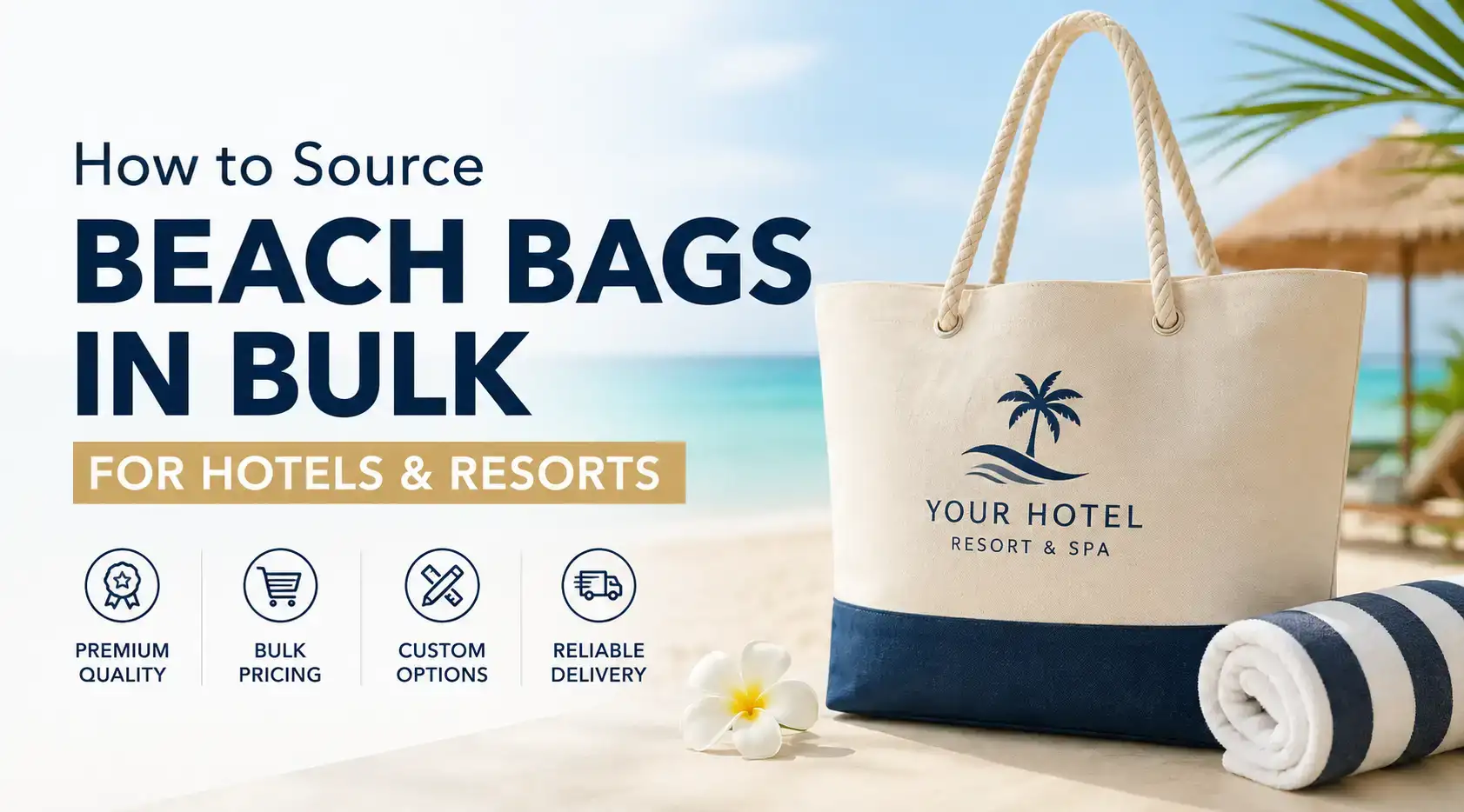
For hospitality procurement teams, a beach bag is not a minor line item. It is one of the few branded touchpoints that travels with the guest beyond the property, and one of the first items that signals whether your amenity program is managed to a standard or assembled on the fly.
The global luxury hotel market is a mature economic sector that is projected to reach $189.68 billion in 2026. Currently there has been a fundamental shift in consumer behavior in this sector. According to this shift hotel customers increasingly prioritize experiential luxury and personalized services. In that context, procurement decisions that once felt minor, like sourcing bulk beach bags for hotels, now carry real brand weight and can help boost brand loyalty.
But sourcing at scale for hospitality is not the same as placing a retail order. The expectations are higher, the risks are different, and the consequences of getting it wrong means losing the reputation because the ripple effect affects a lot of customers. This guide walks you through what to consider and how to build a sourcing program that holds up season after season.
If you have been in hospitality procurement long enough, you already know this truth: buying for a luxury property is fundamentally different from buying for retail or events.
Volume alone does not define the challenge. It is consistency. A guest staying at your flagship Caribbean property and your sister resort in Phuket should receive a bag that looks, feels, and functions identically. Any visible variance in stitching quality, color tone, or handle strength between batches immediately signals a lapse in standards. Guests notice.
The hotel supply market is currently characterized by the "luxury leap," where 58% of guests now prefer premium or luxury room experiences. That is your buyer. They are not comparing your beach bag to a market stall tote. They are comparing it to what the last five-star resort handed them.
There is also the cost of reactive sourcing to consider. When a property runs out of bags mid-season and places an emergency order, lead times are compressed, and quality checks are often skipped from the supplier’s end. A well-structured and planned procurement program eliminates that kind of disaster.
The difference between a standard hotel and a luxury one, when it comes to wholesale beach bags for resorts, comes down to three things: material specification, branding precision, and supplier accountability. Each of those deserves its own attention.
Not all beach bag materials deliver the same performance during exposure to salt air, sunscreen, and sand. Choosing the wrong fabric material for your beach bag means accelerated wear, color fade, or tearing. Even a minor fault reflects really negatively on guests who are staying at a reasonably good resort.
| Material | Key Properties | Best For | Watch Out For |
|---|---|---|---|
| Canvas (Cotton) | Natural, breathable, dye-friendly, premium texture | Upscale resort amenity bags, branded gift sets | Absorbs moisture; may mildew if not dried properly in humid climates |
| Oxford Fabric (Polyester) | Durable, water-resistant, easy to clean, affordable | High-turnover beach programs, pool decks | Lower perceived luxury feel; choose heavier GSM for premium appearance |
| Polyester | Lightweight, color-fast, very cost-effective | Budget amenity tiers, high-volume properties | Can feel thin; opt for 600D or higher denier for durability |
| PVC | Fully waterproof, easy to wipe clean, transparent options available | Wet zone beach areas, pool-to-spa transitions | Less eco-friendly; check for phthalate compliance in regulated markets |
| Jute | Natural, biodegradable, rustic premium aesthetic | Eco-resort programs, sustainability-led properties | Lower durability in wet or humid conditions; limited branding methods |
| Nylon | Lightweight, strong, fast-drying, excellent abrasion resistance | Active beach programs, water sports properties | May look casual; works best with premium hardware and detailing |
| Performance Factor | Minimum Standard for Hospitality Use | Premium Tier Recommendation |
|---|---|---|
| Fabric Weight (Polyester/Oxford) | 420D | 600D or above |
| Seam Strength | Double-stitched at stress points | Reinforced bartack stitching at handles and base |
| Handle Load Capacity | 5 kg minimum | 8 to 10 kg for large-capacity resort bags |
| Color Fastness (Washing) | Grade 3-4 (ISO 105-C06) | Grade 4-5 |
| Color Fastness (Light Exposure) | Grade 3 (ISO 105-B02) | Grade 4 or above for outdoor UV exposure |
| Zipper Rating | YKK or equivalent, 500 open-close cycles | 1,000+ open-close cycles for daily-use programs |
| Base Reinforcement | Single layer | Foam-padded or board-lined base for structural integrity |
These benchmarks matter most when you are specifying your order. Ask your hotel beach bag supplier for test reports against these standards before approving a sample. A supplier who cannot provide documentation against at least the minimum standard is a supplier worth reconsidering.
Custom branding on guest-facing items enhances hyper-personalization, reinforcing the hotel's unique identity. It also means that the guests will recommend the hotel to their friends and relatives. A well-branded beach bag is not just functional accessory. It conveys your resort’s exclusiveness. If you are still deciding between bag formats for your amenity program, our Shopping Bags vs. Tote Bags guide covers the practical differences for procurement buyers.
Here is a breakdown of the most common branding methods and where they work best:
Screen Printing: Cost-effective for solid logos on polyester and canvas. Works well at scale but can crack over time on fabrics exposed to frequent washing or salt water. Screen printing works well for seasonal programs.
Embroidery: This has a special appeal because the raised embroidered surface immediately looks premium, and durable. It is perfect for canvas and Oxford fabric bags at luxury properties. Carries a perceived value that printing cannot replicate.
Heat Transfer: These logos have a sharp detail reproduction, suitable for multi-color designs. Works on most synthetic fabrics. Durability depends heavily on application quality.
Hot Stamping and Embossed Hardware: Premium finishing option for metal zipper pulls, buckles, and clasp details. Adds a refined, bespoke feel suited to five-star positioning.
Beyond the logo, you need to think about color uniformity across batches. A Pantone color reference submitted with your first order should be matched against every subsequent production run. Even a slight variation in your brand color across different hotel branch locations or seasons is worth highlighting before production completes.
Sizing and compartment layout also deserve attention. A custom branded beach bag for a resort with a spa and a beach program simultaneously may need interior compartments for sunscreen, a zippered wet pocket, and a separate shoe sleeve. You need to specify these additional features in the initial spec sheet.
When briefing your supplier, your customization spec should include: Pantone color codes, logo vector file (AI or EPS), preferred branding method, bag dimensions, hardware finish preference, and internal layout requirements. The more precise your brief, the lower will be the hassle for branding revisions.
This is where procurement decisions either protect your property or expose it to operational risk.
Minimum Order Quantities (MOQs)for bulk beach bags for hotels usually range from 200 to 500 units per SKU for standard suppliers, with custom branding often requiring higher minimums. If you are procuring for a single hotel location with one seasonal design, you will not be needing much MOQ planning. But planning becomes increasinly important in a hotel chain.
Lead times for custom beach bag orders generally fall between 30 and 60 days from sample approval to shipment. Add in the ocean freight time of 15 to 30 days and you are looking at a procurement-to-arrival window of 6 to 12 weeks in most scenarios. That is your buffer. Plan backwards from your season opening date, not forwards from when you remember to place the order.
A few practical principles worth holding to:
Never assume last year's timeline holds. Production schedules at factories fill up fast ahead of peak travel seasons. A supplier that delivered in 35 days last year may quote 55 days this year.
Build a safety stock buffer of 10 to 15%.Especially for hotel deal packages in which the bags are meant to be given to the customer.
Negotiate phased or split deliveries where possible. A first shipment covers opening-season needs; a second shipment, triggered by actual consumption data, fills the gap without over-committing capital.
Lock pricing before season. Raw material and freight costs fluctuate. A confirmed purchase order with a fixed unit price protects your budget from mid-season surprises.
Running procurement for a hotel group or resort chain introduces a layer of complexity that single-property buyers rarely face. Consistency across locations, property-level customization, and centralized cost control all have to coexist, and they do not always do so naturally.
The most common challenge is maintaining visual consistency while allowing for location-specific branding. Your Maldives property and your Bali resort may each need their own logo variant or design element, but the bag construction, material grade, and hardware quality must be identical. Specify this clearly in your supplier agreement as a non-negotiable production standard.
Centralized procurement generally delivers better unit economics through consolidated volume. However, decentralized receiving, where each property takes delivery directly, reduces freight consolidation costs and eliminates the need for inter-property distribution logistics. A hybrid model, where procurement is centralized but delivery is split by location, often works best for multi-property groups.
For your supplier agreement, include the following protections:
Master spec sheet lock-in: All properties must receive product produced to identical material and construction standards.
Separate branding sign-off per property: Each hotel location approves its own artwork proof before production begins.
Consolidated invoicing with split delivery: One purchase order, multiple delivery addresses.
Batch traceability:Each shipment should carry a production batch reference so quality issues can be traced to source.
Do not leave multi-property management to informal agreements. What goes unwritten in a supplier relationship rarely goes in your favor when a problem surfaces.
Quality control in hospitality procurement is not optional. It is risk management. A bag that fails structurally (a broken handle, a split seam, a zipper that jams) reflects directly on your property, not your supplier.
Here is what a robust QC framework looks like for wholesale beach bags for resorts:
Pre-Production: This involves confirmation of material specifications, color samples, hardware samples, and construction details. It is done before bulk production begins.
During Production (In-Line Inspection): If ordering at significant volume, request an in-line inspection at 30 to 50% production completion. This catches issues early enough to correct without delaying the entire order.
Pre-Shipment Inspection:This is non-negotiable. A pre-shipment inspection is conducted by your supplier's QC team or an independent third-party inspector. A comprehensive inspection should cover the following: measurement conformance, stitching integrity, zipper function testing, color fastness visual check, print or embroidery quality, and carton count verification.
Industry data from hotel procurement surveys conducted across the EU in 2025 indicates that a significant majority of four- and five-star properties plan to transition away from single-use plastic amenities by the end of 2026. If your property is operating in or exporting to regulated markets, material compliance, particularly around PVC and plastic components, is a documentation requirement, not just a preference. We have covered compliance verification frameworks in depth for school bag exporters, and the same documentation principles apply to beach bag procurement for regulated markets.
Never accept a substituted material or hardware component without a formal change notice and re-approval. Batch substitutions are one of the most common quality failures in offshore production and among the easiest to prevent with clear contractual terms.
Use this checklist as your operational framework before committing to any hotel beach bag supplier.
Confirm manufacturing capability and production capacity for your required volume
Verify export experience and familiarity with your destination country's import regulations
Ordering and evaluation of pre-production samples against your full spec sheet that you submitted earlier.
Test rigorously four aspects: material durability, zipper function, handle load, and color accuracy
Confirm Pantone or physical color standard match
Sign off formally in writing before bulk production is authorized
Approve artwork proof for every design variant
Confirm branding method, logo placement dimensions, and selected thread or ink colors
Confirm unit price, MOQ per SKU, and total order value in writing
Lock in pricing for the full season
Clarify payment terms and deposit structure
Confirm production start date and estimated completion date
Agree on milestones: in-line inspection date, pre-shipment inspection date, and ship date
Build your internal procurement timeline backwards from your season opening date
Conduct or commission a pre-shipment inspection before goods are released
Review inspection report and approve or raise corrective action before shipment
Confirm carton count and packing list against purchase order details.
Log batch reference numbers for traceability
Vaelobag Global is a trusted manufacturer of cosmetic bags and tote bags, combining premium craftsmanship with efficient ODM and OEM solutions to serve both established and emerging brands worldwide. For luxury hospitality buyers, that combination of manufacturing depth and customization capability is precisely what a structured beach bag procurement program requires.
Located in Shantou City, Vaelobag Global operates as a design, development, and production company that integrates domestic and foreign trade, producing Oxford, fabric, and imitation leather bags with logo options including printing, embroidery, hot stamping, embossing, and silk screen printing. That range of branding methods means you are not forced into a single technique. You choose what fits your property's aesthetic.
Dedicated to premium bag craftsmanship and quality, Vaelobag Global offers a streamlined process from design to quality control. You can learn more about our manufacturing background and capabilities on our About Us page.
For procurement heads managing tight seasonal timelines, a supplier like Vaelobag Global that has its own integrated design-to-QC workflow reduces the burden for quality control dramatically.
Vaelobag Global also offers DDP solutions, door-to-door delivery with customs handled, for bag orders. For multi-property groups importing across different countries, that is a meaningful operational advantage. You are not managing freight forwarders, customs brokers, and delivery agents as separate relationships. Vaelobag Global handles it.
With extensive experience in custom design and manufacturing for global clients, Vaelobag Global is positioned to support hotel groups that need consistent quality across high-volume, multi-variant, multi-destination orders. That is the exact scenario most luxury resort procurement heads are navigating.
Sourcing bulk beach bags for hotels is not a one-off transaction. Done well, it is a planned procurement program built on supplier accountability, material integrity, and branding precision.
The hotels and resorts that get this right do not just avoid procurement headaches. They also succeed in delivering a guest experience that is consistent, and quietly branded at every touchpoint. That is what separates a luxury resort's beach program from everyone else's.
The properties that get this right build sourcing programs that run quietly and reliably season after season. That starts with the right supplier relationship, the right specifications, and enough lead time to do it properly.
If you are adding private label cosmetic bags to your beauty product line, the biggest sourcing mistake is treating them like a standard stock purchase....
READ FULLNothing makes a retail season fail faster than a shipment of subpar tote bags. You've been there, or at least you've heard the horror stories from fellow distributors: ...
READ FULLTo start a bag business, choose a profitable bag niche, define your target customer, select a business model such as wholesal...
READ FULL